| 

Guatemala: Supreme
Court Verdict in Mack Case Tremendous Victory (01/22/04)
Prominent
Children's Rights Activist, Bruce Harris, to Go on Trial in Guatemala (01/16/04)
LCHR to Guatemalan President:
Action Needed to Protect Freedom of Speech (01/15/04)
LCHR sends letter to new
Guatemalan President (01/14/04)
Inter-American Court Rules in Favor
Mack (12/19/03)
Guatemala: U.N. Should Advance Investigative Commission(10/09/03)
Guatemalan Forensic Anthropologists Face Threats and Intimidation (07/08/03)
Public Prosecutor from Mack Case Faces Threats, Intimidation (02/04/03)
Guatemala:
LCHR Supports Commission to Investigate Illegal Armed Groups (01/17/03)
Juan Chanay Pablo, killed 1993
Judge Epaminondas González
Dubón, killed 1994
Arnoldo Xi, disappeared
1995
Lucía Tiu Tum and Miguel
Us Mejía (killed 1996), and José Sucunú Panjoj, disappeared 1994
Hugo Rolando Duarte Cordón,
killed 1998
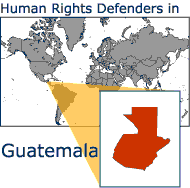
Human Rights Defenders
attacked, 1999 to 2002
The case of Myrna Mack,
killed in 1990
LCHR Welcomes UN Decision
to Extend Mission in Guatemala (11/18/02)
LCHR
letter on Human Rights Offices Ransacked in Guatemala (07/24/02)
Human Rights Conditions
Deteriorating Ltr. to Sec. Powell (07/22/02)
LCHR
disturbed by threats against human rights workers in Guatemala (06/14/02)
LCHR
concerned by recent threats against Guatemalan human rights workers (03/28/02)
Leaflet
distributed threatening Catholic Priests
Translation
of the leaflet

Myrna Mack Foundation
Guatemala
Memory of Silence
Rigoberta Menchu Tum Foundation
Centro de Accion Legal para los
Derechos Humanos

Guatemala
Human Rights
Defenders Project
For more information,
please contact
Kristin Flood,
Tel: 212 845 5298 |
 |
|
|
Juan
Chanay Pablo, anti-PAC demonstrator, killed in Colotenango in 1993[1]
Juan Chanay Pablo, a member of the Committee for
Peasant Unity of Colotenango, was killed in August 1993 in Colotenango,
Huehuetenango, by members of a local Civilian Defense Patrol (PAC).
[2]After a peaceful protest against
illegal PAC activities, PAC members fired on the dispersing crowd,
killing Chanay and injuring several others. Shortly after, witnesses
and others involved in the case were threatened with death and physically
attacked.[3]
The prosecution of Chanay’s attackers has been continually
marred by irregularities. The government initially issued fifteen
arrest warrants, but only detained five people in 1994, who were
subsequently released for lack of evidence or on personal bond.
According to the United Nations Mission for the Verification of
Human Rights in Guatemala (MINUGUA),[4] the initial judge handling the case treated defense
witnesses more favorably than prosecution witnesses. By the end
of 1995, eight PAC members were in jail; in 1996, they were all
acquitted for lack of evidence. The public prosecutor’s office
appealed the decision and in 1998 twelve[5] PAC members were sentenced
to ten years in jail, a sentence that was extended in July of that
year to 27 years each. Others remained at large and former Brigadier
General Luis Felipe Miranda Trejo, suspected as the intellectual
author of the crime and for attempting to cover it up, was not prosecuted.[6]
Meanwhile, Chanay’s family brought a complaint
to the Inter-American Commission for Human Rights, which reached
a “friendly settlement”[7]between the government and the family in February
1997. This was first time the Guatemalan government had settled
a case of this type, and it has since done so in a number of other
cases. The agreement reached stipulated that the state should provide
financial reparation to the victims for PAC actions in Colotenango
and continue criminal proceedings against those involved in the
attack. The government made a payment to Chanay’s family and
initiated public works projects in the area, per the agreement.
The convictions of twelve PAC members for Chanay’s killing
were upheld in April 1999 by an appellate court, and their sentences
adjusted to 25 years. A day later, 500 armed people stormed the
police station in Huehuetenango, freeing the twelve prisoners. Arrest
warrants were issued for the escapees but, although it was suspected
that they returned to their hometown and were being protected by
former PAC members, none of them were brought back into custody.
According to the Campesino Unity Committee, security forces were
aware of their location, but didn’t arrest them because there
was “no operational plan to that effect.”[8] Subsequent to the jailbreak, threats against
family members and witnesses in the case increased. MINUGUA reported
that it was believed the military or former PAC members orchestrated
the escape. In November 1999, Brigadier General Miranda Trejo was
elected to Congress for the 2000-2004 period and thus received immunity
from prosecution for any role in the killing that he may have had.
Endnotes
[1] Main sources:
Inter-American Commission on Human Rights (IACHR), Friendly Settlement,
Case 11.212 Guatemala, Report No. 19/97 (March 1997); United Nations
Verification Mission in Guatemala, Third Report, (hereinafter “MINUGUA
Report”), A/55/174 (July 2000); and U.S. State Department
Bureau of Democracy, Human Rights, and Labor, Country Report on
Human Rights Practices, Guatemala, (hereinafter “Country Reports”)
1993 to 2000.
[2] PACs were formed in the early
1980s throughout the country as party of the military government’s
counter-insurgency policy. Membership was essentially compulsory
and subject to army control. PACs, consisting of more than 300,000
armed men, were responsible for wide-spread human rights violations
during the civil war. In 1994, the government renamed them Voluntary
Civil Defense Committees (CVDCs) and in 1996 they were formally
disbanded in line with the Peace Accords. They continue to operate
informally, and human rights groups allege they are responsible
for violence and rights violations.
[3] The Inter-American Court of Human Rights ordered
the Guatemalan government to take precautionary measures to protect
witnesses and family members in June 1994, after the IACHR requested
similar measures in November 1993. The order of the Court was confirmed
by resolutions in December 1994, September 1997, February 2000,
and September 2001.
[4] MINUGUA was established in 1994, pursuant
to a UN General Assembly resolution and during negotiations between
the Government of Guatemala and the URNG, to verify compliance with
and implementation of the Comprehensive Agreement on Human Rights,
signed by both parties in March 1994. The Agreement requested the
establishment of a UN mission to “receive, consider and follow
up complaints of possible human rights violations; establish whether
the competent national institutions had carried out the necessary
investigations autonomously, effectively and in accordance with
Guatemalan and international human rights norms; and determine whether
or not a violation had occurred.” MINUGUA Report, A/49/856
(March 1995).
[5] According to Country Reports 1998 and 1999,
eleven former PAC members were sentenced in 1998, but the sentences
for twelve former PAC members were confirmed in 1999. All other
sources, regarding incidents in 1999, refer to twelve convicted
individuals.
[6]Miranda was being investigated in the murder and
is referred to in Country Reports as “the alleged intellectual
author of the killing.” He was never charged.
[7] Article 48 of the American Convention on
Human Rights mandates the IACHR to pursue a friendly settlement
between an individual making a complaint about the commission of
human rights violations and the relevant state. Should such a settlement
prove impossible, the Commission may make further investigations
and reach a decision on state responsibility for the violations
alleged.
[8]Guatemalan Human Rights Commission (GHRC)/USA, Guatemala
Human Rights UPDATE, No. 9 & 10 (1999).
|