|
||||||||||||||||
|
|||||||||||||||||
|
PROGRAMS
 |
| |
ABOUT US
|
| | CONTRIBUTE | | |
MEDIA ROOM |
| |
 |
|
|
||||||||||||
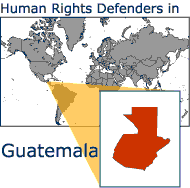
Disclosure of Military Documents The New Proceeding: The Admission of State Responsibility  Guatemala: Supreme Court Verdict in Mack Case Tremendous Victory (01/22/04) Inter-American Court Rules in Favor Mack (12/19/03) Analysis of Appeals Court Decision (06/16/03) Analisis de la Sentencia de la Corte de Apelaciones (06/16/03) Appeals Decision in Mack case a step backwards (5/7/03) A Test of Justice: LCHR Report on Myrna Mack Murder (04/18/03) Guatemala: State Withdraws from Inter-American Court Hearing on Mack Case (02/25/03) Public Prosecutor from Mack Case Faces Threats, Intimidation (02/04/03) LCHR Calls for Investigation into Threats Surrounding Mack Case Lawyers Committee Hails Conviction of Juan Valencia Osorio for Murder of Myrna Mack (10/04/02)  Myrna Mack Guatemala Human Rights Defenders Project For more information, please contact Kristin Flood, Tel: 212 845 5298 |
|
|
|
The Murder of Myrna Mack, Initial Investigation, and Conviction of Noel de Jesús Beteta Myrna Mack was a 40-year-old Guatemalan anthropologist who conducted pioneering fieldwork on the destruction of rural indigenous communities resulting from military counterinsurgency tactics in Guatemala's armed conflict. On September 11, 1990, she was attacked, stabbed 27 times, and killed by two individuals as she left her office to return home. During the previous two weeks, Myrna Mack had been stalked by a military death squad. Soon after the murder, her sister, Helen Mack, asked LCHR to generate support for her efforts to prosecute the killers in Guatemala, and to initiate an action before the Inter-American Commission on Human Rights of the Organization of American States (the "Commission") denouncing the murder and requesting clarification and investigation of the incident. Agents of the Criminal Investigations Department, under the direction of the General Director of the Police, arrived at the scene immediately after the murder and began their investigations. The Justice of the Peace on duty also appeared at the murder scene and ordered that Myrna Mack's corpse be taken to the Forensic Services Office for Autopsies. The autopsy failed to include any analysis of the pieces of skin found under Myrna Mack’s fingernails that presumably belonged to the aggressors. The Criminal Investigations Department’s investigations raised much concern due to negligent acts and omissions which endangered and obstructed the assignment of responsibility in the case. There were several instances of attempts to cover up government involvement, including destruction and "loss" of evidence by police, the hiding of police reports that Myrna Mack had been under surveillance, inaction by judicial officials, and stonewalling by the Defense Ministry after attempts to gain information about the case. In a report dated September 29, 1990, chief homicide investigator José Mérida Escobar identified Noel de Jesús Beteta, a low-ranking member of the Presidential General Staff (Estado Mayor Presidencial or EMP ), as a suspect in the killing. The Presidential General Staff is a military intelligence unit implicated in numerous human rights violations. The report concluded that Beteta acted under orders from his superiors, high-level officials of the EMP, and that the killing of Myrna Mack was carried out for motives related to her work with refugees and displaced persons. On August 5, 1991, Mérida Escobar was shot and killed less than 100 yards from National Police headquarters. Julio César Perez, who had worked with Merída Escobar in the investigation, decided to leave Guatemala after receiving threats. Other key witnesses were silenced or forced to leave the country due to threats. A new police report then concluded that the motive for the murder was robbery. The report, which failed to demonstrate efforts at independent evaluation or investigation, does not explain why the persons who attacked Ms. Mack took her portfolio and purse but not her jewelry or her car. The Public Ministry pursued a criminal investigation, prosecution and trial of Beteta, the suspected "material author" of the murder named in the September 29, 1990, police report. Helen Mack, along with a private attorney, acted as a private prosecutor, working independently of the Public Ministry prosecutors assigned to the case. She took on this role -- provided under Guatemalan law -- in October 1990 out of frustration with the slow process of the investigation. It was only due to her intervention that the case moved forward. As private prosecutor, Helen Mack attempted to include as defendants Edgar Agosto Godoy Gaitan, Juan Valencia Osorio, and Juan Guillermo Oliva Carrera, Beteta’s superior officers and the alleged “intellectual authors” of the crime. In an attempt to gather evidence for the three officers’ involvement, both the private and public prosecutors sought information and documents from state agencies, including the Defense Ministry and the EMP. The agencies rejected the requests on the grounds that the information was confidential and included State secrets. Helen Mack was frustrated in her repeated attempts to obtain a protective order to prevent the loss of evidence critical to the investigation of other officers' alleged involvement in the crime or its cover-up. After the trial court refused to order production of these documents in 1992, the Court of Appeals reversed the decision, ordering documents to be subpoenaed from the Defense Ministry. Some of the documents ultimately provided by the military appear to have been altered. In February 1992, a judge ordered the case sent to military courts on the grounds that the suspect was on active duty at the time of the crime. The military justice system had a record of near total impunity for human rights crimes. The public prosecutor and Helen Mack appealed that decision. On March 27, 1992, the appellate court reversed the trial court and ordered that the case be heard in a civilian court. The judge who then took over the case notified the parties of the opening of the trial period in May 1992. Helen Mack filed an appeal seeking to adduce evidence that the murder was a premeditated and planned action and asked the court to define the inquiry at trial to include the identity of those responsible for the conception and planning of the murder. After the appeal was denied, she launched a second appeal on the grounds that the presiding judge had improperly denied various evidentiary requests. This appeal was allowed, and another judge took over the case. The prosecution's case included numerous sources who testified (or submitted written responses to questions from the court) that Myrna Mack's killing had all the earmarks of a political crime. Leonel Fernando Gomez Rebulla, the Director of Investigations for the Human Rights Ombudsman's Office,1 testified on August 26, 1992, to his office's preliminary conclusion that Mack's murder fit the profile of a political crime: "an extrajudicial death for political motives, possibly effectuated by the security forces of the state." 2 Lastly, he informed the court that since 1991, unidentified persons on foot and in vehicles without license plates had maintained a presence outside the Mack family home. General Edgar Godoy Gaitan (ret.), the head of the EMP at the time of the murder, testified before the court on three separate occasions. Although the range of the prosecution's questioning was severely limited by the prosecuting judge, even General Godoy's description of the EMP's activities suggests a military intelligence apparatus rather than a security detail for the President. He acknowledged that the role of the EMP was to analyze the "factors of power" within Guatemala. Though he denied that analysis extended to issues surrounding displaced persons, refugees and repatriates that formed the basis for Myrna Mack’s anthropological work, witnesses from a governmental commission for refugee assistance told the court that EMP personnel maintained contact with their office to get information on matters affecting refugees and displaced persons. In February 1993 the court convicted and sentenced Beteta to 25 years in prison. He became one of a tiny fraternity of Guatemalan security force personnel ever convicted for a human rights violation. Achieved in spite of violence and intimidation against many actors involved in the case, the conviction was a milestone in Helen Mack's extraordinary struggle to establish a lasting precedent against impunity. The case attracted international media attention, won an international award for Helen Mack, and was memorialized as an explicit U.S. foreign policy concern. next>> 1 Guatemala's Human Rights Ombudsman Ramiro de León Carpio at the time (later Guatemala's President) stated publicly that:the plight of Guatemala's refugees and displaced persons is a politically sensitive topic;
2 Gomez added that Myrna Mack's injuries did not correspond to those normally inflicted by common criminals in the course of a robbery. |
|||||||||

|
|||||||||||||