|
||||||||||||||||
|
|||||||||||||||||
|
PROGRAMS
 |
| |
ABOUT US
|
| | CONTRIBUTE | | |
MEDIA ROOM |
| |
 |
|
|
||||||||||||

|
|
|
|
Human Rights Defenders in Kuwait
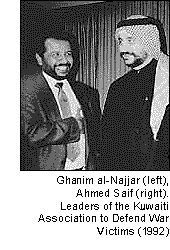
The collapse of the Kuwaiti government during the Iraqi occupation left a vacuum that was filled by a resistance movement with a voluntary leadership drawn largely from outside the country’s traditional elites. After the war, these leaders remained active in non-governmental community organizations, including the Kuwaiti Association to Defend War Victims, (KADWV). These groups campaigned for reform, and for an end to violations of human rights against non-Kuwaiti Arabs that had proliferated in the months after liberation. They struck a chord with the Kuwaiti people in their high-profile work on behalf of Kuwaitis missing after the war who were believed to be held captive by the Iraqi government. The KADWV was notable because it based its work explicitly on international human rights standards, and established cooperative relationships with international human rights organizations. It became the focal point for activities in Kuwait by numerous international human rights organizations at a level that had not been seen before the war. Independent human rights groups and community organizations played an active role in the run-up to parliamentary elections in October 1992, which saw the election of a reform-minded parliament in the previously suspended legislative assembly. The electorate was very small, only 80,000 male “first class” Kuwaiti citizens were eligible to vote, but one area slated for reform was in broadening the franchise to include other citizens, including women. In the months prior to the election, the U.S. and other Western governments were very supportive of the “restoration of democracy” in Kuwait, and gave encouragement to proposals for legal reform, revising nationality laws and extending the vote to women. Such developments were in accordance with rhetoric that had been used by the U.S. during the war, characterizing the struggle against Iraq as a fight for freedom, democracy and human rights. After the election, momentum went out of the reform efforts. The ruling family was stung by the parliament’s exposure of corruption scandals involving family members, and embarrassed by the continuing high-profile of NGO efforts on behalf of missing POWs, which outshone a lack-luster official initiative. Politics as usual returned to Kuwait, and the family started to play off competing interest groups against each other: Sunni against Shi’ite Muslim, Islamist against secularist, each clan against another. Neighboring Saudi Arabia let its displeasure over Kuwait’s reform agenda be known. The West stood by as the reform agenda was left to wither from inattention. The U.S. and other western states did not make use of the significant political capital they had earned by restoring the al-Sabah family to power in reminding the Kuwaiti government of its obligation to fulfil promises it had made to its own people, and to the international community, to restore democratic values to Kuwait. In August 1993, the Kuwaiti government ordered the closure of all unlicensed voluntary organizations, a measure transparently directed at groups like KADWV, which had been most active in advancing a reform agenda. Protests from these groups were quickly stifled as the government exerted its considerable influence over the press and parliament. Organized advocacy of human rights reform was pushed back to the margins of Kuwaiti political life, and progress towards more democratic governance in Kuwait remained stalled. Today there are no active, independent, local human rights organizations engaged in monitoring domestic human rights conditions in Kuwait. |
|||||||||

|
|||||||||||||



 After
the Gulf War, the Kuwaiti people were, on the whole, pleased to
welcome back the ruling al-Sabah family, despite the many shortcomings
in its prior governance. However, there also was a strong sentiment
among many Kuwaitis that the family should return to rule in accordance
with the Constitution, showing due respect for the rule of law and
democratic process.
After
the Gulf War, the Kuwaiti people were, on the whole, pleased to
welcome back the ruling al-Sabah family, despite the many shortcomings
in its prior governance. However, there also was a strong sentiment
among many Kuwaitis that the family should return to rule in accordance
with the Constitution, showing due respect for the rule of law and
democratic process.