|
||||||||||||||||
|
|||||||||||||||||
|
PROGRAMS
 |
| |
ABOUT US
|
| | CONTRIBUTE | | |
MEDIA ROOM |
| |
 |
|
|
||||||||||||
|
 Lawyers Committee Applauds Egyptian Court Ruling on New Women's Research Center (10/28/03) Call for the Immediate Release of Egyptian Ashraf Ibrahim (09/18/03) Egypt: Human Rights Organizations "Closed" Due to Implementation of New Law on Associations (6/11/03) Lawyers Committee Condemns Crackdown on Dissidents in Egypt (03/27/03) Egypt's new law on associations: an attack on civil society Saad Ibrahim: Egypt's Best Known Activist Acquitted
|
|
|
|
Human Rights Defenders in Egypt
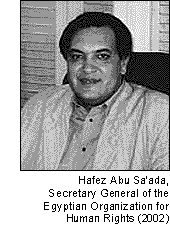
The de-liberalization of Egypt over the course of the past decade is clearly visible in measures taken by the government to close down institutions that had previously provided political space to dissident or opposition opinion. Coupled with the further erosion in the strength of opposition political parties, the government moved in 1993 to wrest control of the professional syndicates, like those of lawyers, doctors and engineers, from opposition control. In 1995 and 1996, the government strengthened its powers to silence journalists and opposition newspapers critical of government policies, and throughout the nineties the government continued to manipulate election results to ensure overwhelming dominance for the ruling party. In the early 1990s, the independent non-governmental human rights movement emerged as a challenge to the state’s growing control over the society. The state was made aware of this challenge by the movement’s success in forging strong ties with international partners, and its high visibility in the international media. Moreover, at a series of major international UN conferences, including the population conference in Cairo in 1994, Egyptian NGOs were highly visible and effective in communicating their messages to the international community. By the mid-1990s, the Egyptian government grew increasingly weary of this criticism, and of the vociferous independent NGO sector. The government turned to the law to limit dissent. In January 1995, the Legislative Department of the Ministry of Justice issued a ruling declaring that not for profit civil companies, the legal form favored by almost all NGOs that had emerged in the early nineties, were illegal. “ In as much as these companies have failed to comply with the provisions of Law 32 of 1964 (the law on associations) then they are committing a criminal offense and are liable to punishment…,” it declared. The ruling demanded that they should seek registration under the law on associations, or face prosecution. NGOs had adopted this novel legal form precisely to avoid having to register under Law 32 of 1964, the restrictive law on associations which gave the government intrusive powers to control the work of NGOs. The organization from which the movement had sprung, the Egyptian Organization for Human Rights, had tried to register under the law in 1985, but after protracted legal proceedings, its application had been turned down. Government officials began to refer to unregistered NGOs as “illegal organizations,” and to condemn these organizations in the government controlled press. The attacks on human rights NGOs in the press focused on three main areas. First, human rights groups were accused of acting against the national interest, and of being in the pay of foreign powers—a direct reference to the movement’s dependence on foreign funding. Secondly, human rights groups were accused of giving aid and comfort to terrorists because of their reporting on government violations during its crackdown on violent Islamic extremists. Thirdly, their lack of legal registration was emphasized to show their illegitimacy. For example, amid a series of scathing statements about human rights organizations from Minister of Interior, Hassan al Alfi, he declared in September 1995 that the EOHR’s report on prison conditions were “sheer lies and fabrications… and are simply aimed at tarnishing Egypt’s image.” Human rights activists were variously described by the minister as “criminals,” “weirdos,” and “people with an axe to grind,” in an interview in Al Ahram newspaper on August 26, 1995. The campaign against human rights activists was intensified when, on December 1, 1998, Hafez Abu Sa’ada, Secretary General of the Egyptian Organization for Human Rights (EOHR) was taken into detention and accused of taking money from foreign sources to defame the reputation of Egypt abroad. The accusations related to an EOHR report about human rights violations in the predominantly Christian village of al-Kushh, in Upper Egypt. The government alleged that the EOHR had taken a £25,000 ($40,000) grant from the British Parliamentary Human Rights Association as payment for producing defamatory material about Egypt. The grant was actually received to support a women’s education project, which had no connection with EOHR’s reporting on Upper Egypt. Hafez Abu Sa’ada was released on bail after six days in detention, but the charges against him, and the investigation into EOHR’s reporting on sensitive issues involving Egypt’s Christian minority, were not dropped. On February 13, 2000, the public prosecutor announced that Hafez Abu Sa’ada and the EOHR lawyer who had conducted the fieldwork in al- Kushh, Mustafa Zeidan were to be brought to trial before an Emergency State Security Court in Cairo. Among the charges against them was an alleged violation of Emergency Decree 4 of 1992, which prohibits the receipt of foreign funding without official permission. The charges were announced while Hafez Abu Sa’ada was traveling abroad. After weeks of negotiations, he received assurances from a senior presidential advisor that the prosecution against him would not be pursued, so he returned home. No further steps have been taken to pursue the prosecution, but the charges have not been dismissed. The government’s intention to further restrict the independent activities of human rights NGOs was clear in 1999, in the passage of a revised law on associations. The new law, Law 153 of 1999, was pushed through the parliament in May 1999, disregarding a promising consultative process with some NGO activists, which the government initiated and then reneged upon. The new law, in its Article 11, outlawed “political” activities by NGOs, a loosely defined restriction that could be used to penalize legitimate activities by human rights defenders. Under Article 75 of the law, it also banned the receipt of money from abroad or domestic fund raising without prior permission from the authorities. In June 2000 the Constitutional Court suspended the new law on procedural grounds, but the government declared its intention to apply the law without substantive changes as soon as procedural hurdles were overcome. Perhaps the most devastating blow to the human rights movement came on June 30, 2024 when the government detained Saad Eddin Ibrahim, director of Ibn Khaldoun Center for Development Studies (ICDS). ICDS was a prestigious independent research center which carried out research projects for multilateral institutions, as well as for the Egyptian government. The Center was also associated with various campaigns and causes also espoused by the human rights movement. For many years Dr. Ibrahim and ICDS had championed the idea that promoting civil society was key to promoting democratization in Egypt and the region. ICDS made common cause with other non-governmental organizations in campaigning for a liberalization of the law on associations. The Center also worked in the controversial area of minority rights, and in promoting free and fair elections—the issue which was the immediate cause of Dr. Ibrahim’s detention and prosecution. ICDS and an organization closely associated with it, the Huda Shirawi Center for Women Voters, had received a grant from the European Union for a voter education project, leading up to parliamentary elections held in October 2000. He was held for interrogation until August 10, 2000. He and three of his staff members were then brought to trial before an Emergency State Security Court on November 18, 2000. He was convicted on three charges: receiving foreign funding without permission, a violation of Emergency Decree 4 of 1992, dissemination of false information abroad, and misappropriation of funds, and sentenced to seven years’ hard labor. The misappropriation of funds charge was rejected by the European Union, the donor whose funds were allegedly misappropriated. The EU confirmed that all accounting requirements connected to the grant in question had been satisfied by Dr. Ibrahim and the Center. The other charges were transparently politically motivated. Saad Eddin Ibrahim is a very prominent public figure in Egypt, whose connections to powerful government leaders were believed to have insulated him from state reprisal. His imprisonment sent a clear message that the government was determined to cut off flows of foreign financial support that it does not supervise. NGO activists realized that what nearly happened to Hafez Abu Sa’ada, and what did befall Saad Eddin Ibrahiim could easily happen to them. As a result, organizations reporting on human rights conditions in Egypt, like the EOHR, were obliged to stop accepting foreign funding. Without domestic funds to replace them, they were forced to lay-off staff, close offices and radically curtail activities. Instead of domestic organizations with national membership and research structures, there are now just a few individual activists acting in the name of organizations that no longer exist. Today, a once dynamic and growing human rights movement has been drastically reduced in its status and capacity. As a result the international community has a much less complete picture of human rights developments in the country, especially in provincial regions far from Cairo. By a series of deliberate policy measures and acts of persecution over a period of years the Egyptian government has all but destroyed an independent human rights movement that had developed in Egypt in the late 1980s and early 1990s. The suppression of the human rights movement is of a piece with its long-standing policy of suppressing political opposition of all kinds. The restriction of open political debate in Egypt has contributed to an intellectual climate in which conspiracy theories take the place of academic inquiry, and in which non-violent political participation is increasingly remote from citizens wishing to have a say in how they are governed, and on the issues that impact their lives. The suppression of dissent and of pluralistic political debate on human rights and other issues has led some in Egyptian society to seek an outlet for their political frustration through violent, extremist movements. Egypt suffered grievously from conflicts between violent groups and the government in the 1990s, and Egyptian extremists have become part of an international network, threatening violence and terror around the world. |
|||||||||

|
|||||||||||||




 The
human rights movement began in Egypt in the mid-1980s as former
senior government officials and former activists from the student
movement of the 1960s and 1970s looked for a new direction to put
the country on a path towards economic, social and cultural development.
The promise of Nasser’s revolution and of the post-independence
period had dissipated, and interest was growing in new ideas of
democratization and liberalization to take the place of the one
party state that Egypt had come to resemble.
The
human rights movement began in Egypt in the mid-1980s as former
senior government officials and former activists from the student
movement of the 1960s and 1970s looked for a new direction to put
the country on a path towards economic, social and cultural development.
The promise of Nasser’s revolution and of the post-independence
period had dissipated, and interest was growing in new ideas of
democratization and liberalization to take the place of the one
party state that Egypt had come to resemble.